Why Qwen3.5 Falls Into Infinite Thinking — and How to Fix It
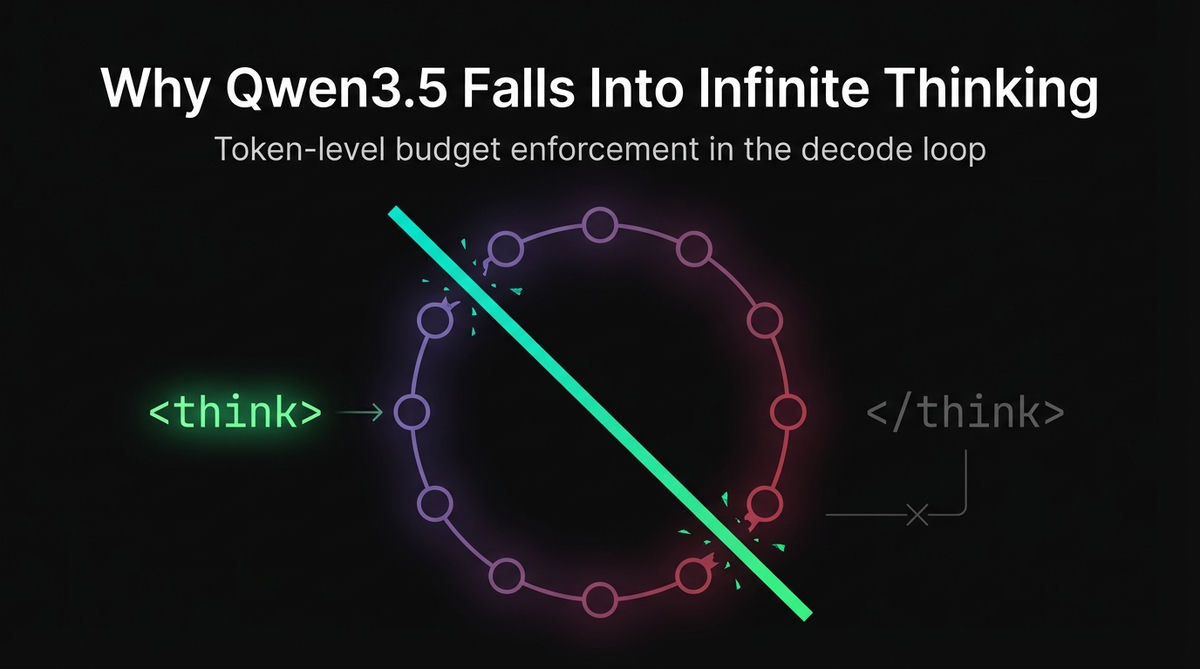
Table of Contents
Token-level budget enforcement that stops reasoning models from thinking forever — implemented in the decode loop, not as post-hoc truncation
The Problem
If you've run Qwen3.5 models locally, you've probably seen this: the model starts thinking... and never stops. It generates thousands of reasoning tokens inside <think>...</think> blocks until it hits max_tokens, and you get either an empty response or a truncated thought with no actual answer.
This isn't a rare edge case. Repetition/Looping issue observed in Qwen3.5-35B-A3B during LiveCodeBench evaluatio#88 measured it: 17.4% of outputs on LiveCodeBench had truncated thinking (no </think> emitted before the token budget ran out). Of those truncated outputs, 84% showed repetition rates above 30% — the model gets stuck repeating phrases in its reasoning phase until tokens run out, never producing an answer.
The problem is worse on harder questions. Easy problems see ~6% truncation; hard problems hit 27.5%.
Users across every local inference framework report this:
- LM Studio #1559#1559: no UI toggle for Qwen3.5 thinking mode (
enable_thinking=falseworks but requires manual API config) - Ollama qwen3.5:35b Looping Issue#14421: Qwen3.5:35b enters endless loops
 Jan bug: Thinking mode not working with Qwen 3.5 9B#7645: thinking mode not working with Qwen3.5
Root Cause: The </think> Token Is Probabilistic
To understand why this happens, you need to understand how Qwen3.5's thinking mode works at the token level.
How the template enters thinking mode
Qwen3.5's chat template has a boolean control called enable_thinking. When enabled (the default), the template appends this to the prompt:
<|im_start|>assistant
<think>
This <think>\n prefix is part of the prompt, not the generation. It tells the model: "start generating reasoning tokens." The model then produces its chain-of-thought, and at some point, it's supposed to emit </think> to transition to the actual answer.
When disabled (enable_thinking=false), the template instead appends:
<|im_start|>assistant
<think>

</think>
A closed, empty think block. The model starts directly in content mode — no reasoning phase.
The fundamental problem
</think> is just another token in the vocabulary (token ID 248069 for Qwen3.5). The model generates it based on a probability distribution over the vocabulary at each decode step. There's no hard guarantee it will ever emit it.
Several factors make </think> emission unreliable:
- Complex prompts extend the reasoning chain. The model keeps exploring different approaches, losing track of when to stop.
- Repetition loops form inside thinking. Once the model starts repeating a phrase, the repetitive pattern reinforces itself and the probability of
</think>drops further. - Quantization shifts the probability distribution. Lower precision (Q3, Q4) subtly degrades the model's ability to produce low-frequency tokens like
</think>at the right moment. - Short context windows (Ollama dynamically defaults to 4k/32k/256k based on VRAM) can cut off the model before it can naturally finish thinking, producing truncated output with no answer.
max_tokens is the wrong safety net
Every inference framework has max_tokens as a hard ceiling. But max_tokens is shared between thinking and content. If the model spends 4,000 tokens thinking in a 4,096 token limit, you get 96 tokens of answer. If max_tokens is hit during thinking, you get zero answer — just an incomplete reasoning chain and finish_reason: "length".
This is the core of the community complaint: the model thinks until the budget is gone, and the user gets nothing useful.
What Local Frameworks Do (and Don't Do)
mlx-lm: Awareness without enforcement
mlx-lm (the Python MLX library behind LM Studio's MLX backend) is aware of thinking tokens but does nothing to enforce limits.
In tokenizer_utils.py, it detects <think>/</think> at init time:
THINK_TOKENS = [
    ("<think>", "</think>"),
    ("<longcat_think>", "</longcat_think>"),
]
for think_start, think_end in THINK_TOKENS:
    if think_start in vocab and think_end in vocab:
        self._think_start_id = vocab[think_start]
        self._think_end_id = vocab[think_end]
        break
In the server, a SequenceStateMachine uses these to label output as "reasoning" vs "normal" for the OpenAI-compatible API response. But this is presentation-only logic. The generate loop in generate.py has exactly two stopping conditions:
while True:
    if n == max_tokens:
        break
    # ...
    yield y.item(), logprobs
    n += 1
Total token count, and EOS. No separate thinking counter, no budget, no forced </think>. The enable_thinking parameter is passed through to apply_chat_template() to change the prompt — it adds zero runtime enforcement.
Ollama: No budget, disable was broken
Ollama has --think/--nothink toggles add thinking support to the api and cli #10584, but:
- No thinking budget — Thinking Budget#10925 is an open feature request that remains unimplemented.
think=falsewas broken in generate API — generate API ignores think=false for qwen3.5 (chat API works)#14793 (closed March 23, 2026) reported thinking tokens silently consuming the entirenum_predictbudget, producing an empty response field.
llama.cpp: Budget added, but buggy
llama.cpp recently added --reasoning-budget N (PR #20297). This is the closest any local framework has come to solving the problem, but it has significant issues:
enable_thinking: falsebroken for Qwen3.5 — Misc. bug: enable_thinking param cannot turn off thinking for qwen3.5#20182- Tool parser fails when text precedes
<tool_call>in thinking/tool-calling flows — Eval bug: unsloth/Qwen3.5-35B-A3B-GGUF `peg-native` chat format parser fails when model outputs text before `<tool_call>` (thinking model + tool calling)#20260 - Grammar enforcement was inactive during thinking — Grammar enforcement not applied when thinking is enabled (response_format + enable_thinking)#20345 (closed March 10, 2026)
- Raw truncation reduces answer quality — Feature Request: Graceful reasoning budget termination. Avoid mid-sentence cutoff.#20632 discusses the need for graceful termination
Summary
| Framework | Budget Enforcement | Disable Thinking | Tool Isolation |
|---|---|---|---|
| mlx-lm | None | Template-only | N/A |
| Ollama | None | Was broken (generate API, now fixed) | N/A |
| llama.cpp | --reasoning-budget (recent) | Broken for Qwen3.5 | Parser issues |
| vLLM | ThinkingTokenBudgetLogitsProcessor | Works | Enforced |
| mlx-node | ReasoningTracker | reasoningEffort API | Enforced |
The vLLM Solution: Logits-Level Budget Enforcement
vLLM solves this with a ThinkingTokenBudgetLogitsProcessor — a token-level intervention during decoding, not post-generation truncation. (See the reasoning outputs docs for details.)
How it works
The processor maintains per-request state:
class ThinkingTokenBudgetLogitsProcessor:
    in_think: bool          # Currently inside <think> block?
    think_count: int        # Thinking tokens generated so far
    in_end: bool            # Currently forcing the end sequence?
    end_count: int          # Progress through end-token sequence
    budget: int             # Maximum thinking tokens allowed
During each decode step:
- The processor scans newly generated tokens for
<think>/</think>transitions - While
in_thinkis true, it incrementsthink_count - When
think_count >= budget, it flipsin_end = True - While
in_endis true, it overrides logits: assigns a huge value to the next token in the</think>sequence, effectively forcing the model to emit</think> - Once the full end sequence is emitted, generation continues normally in content mode
This is a hard decoding-time intervention. The model has no choice — when the budget is hit, </think> is emitted and content generation begins.
The key design principle
Budget enforcement must happen during generation, not after. Post-hoc truncation doesn't work because (1) in streaming mode, clients have already seen the extra reasoning tokens, and (2) the model needs to actually transition to content mode — you can't just chop off thinking and expect coherent content to follow.
Forcing </think> at the token level gives the model the proper transition signal. The model "sees" the </think> token in its context and generates content accordingly, as if it had decided to stop thinking on its own.
The mlx-node Solution: ReasoningTracker + Decode Loop Enforcement
mlx-node implements the same principle — token-level budget enforcement during decoding — but adapts it to the realities of a pipelined, compiled Metal decode loop rather than vLLM's logits processor infrastructure.
Why not a logits processor?
vLLM has a general-purpose logits processor pipeline because it serves many models with different requirements. mlx-node targets Qwen3/Qwen3.5 specifically and runs on a single Apple Silicon device. The decode loop is pipelined and the forward pass can be compiled to a Metal graph via mlx::core::compile. Inserting a logits processor would break the compiled graph and add overhead for a feature that only needs a simple token-level check.
Instead, budget enforcement is built directly into the decode loop as a token substitution.
The ReasoningTracker state machine
pub(crate) struct ReasoningTracker {
    in_thinking: bool,           // Currently in reasoning mode?
    thinking_token_count: i32,   // Tokens generated while thinking
    budget: Option<i32>,         // Max thinking tokens (None = unlimited)
    think_end_id: Option<u32>,   // Token ID for </think>
    force_think_end: bool,       // Budget exhausted, force next step
    end_scheduled: bool,         // Forced token is in the pipeline
}
Three operations drive the state machine:
observe_token(token_id) -> bool — Called after extracting each token. Returns whether the token is reasoning content. When it sees think_end_id, it transitions in_thinking to false. While in_thinking, it increments the counter and sets force_think_end when the budget is reached.
should_force_think_end() -> bool — Checked after the forward pass, before penalties and sampling. When true, the decode loop bypasses penalty calculation and sampling, directly producing the think_end_id token. The forward pass still runs to keep KV caches consistent. Consumes the flag (returns true at most once).
forced_token_id() -> u32 — Returns the </think> token ID to inject.
Initialization
The tracker is initialized from the same enable_thinking value used to render the prompt template:
let enable_thinking = resolve_enable_thinking(&config);

let starts_in_thinking = enable_thinking.unwrap_or(true);

let tracker = ReasoningTracker::new(
    starts_in_thinking,
    config.thinking_token_budget,
    think_end_id,
);
This satisfies vLLM's hard invariant: the tracker configuration must match the template state. When enable_thinking=false, the template injects a closed <think>\n\n</think>\n\n block and the tracker starts with in_thinking=false. When enable_thinking=true (default), the template injects <think>\n and the tracker starts in thinking mode. The think_end_id is passed separately to the tracker — if None (tokenizer lacks a single </think> token), budget enforcement is disabled but the tracker still enters thinking mode, falling back to text-level </think> detection at finalization.
Full Control Flow in mlx-node: Request to Token
Here is the complete path a chat request takes through mlx-node reasoning-aware decode loop.
Step 1: Resolve reasoning effort
The user-facing API is reasoningEffort, which mlx-node maps to enable_thinking for the chat template. Note that vLLM also exposes reasoning_effort as an API parameter, but for Qwen models the template itself only reads enable_thinking — vLLM passes reasoning_effort through as a template kwarg that Qwen templates ignore. mlx-node takes the opinionated approach of mapping reasoningEffort to enable_thinking directly:
fn resolve_enable_thinking(config: &ChatConfig) -> Option<bool> {
    match config.reasoning_effort.as_deref() {
        Some("none") | Some("low") => Some(false),
        Some("medium") | Some("high") => Some(true),
        _ => None, // template decides (typically true)
    }
}
reasoning_effort: "none" also defaults include_reasoning to false, meaning the thinking field is suppressed in the output.
Step 2: Render the prompt
The resolved enable_thinking is passed to the Jinja2 chat template:
let tokens = tokenizer.apply_chat_template_sync(
    &messages, Some(true), tool_defs, enable_thinking,
);
The template outputs either <think>\n (thinking enabled) or <think>\n\n</think>\n\n (thinking disabled) before the assistant's generation position.
Step 3: Initialize the tracker
let starts_in_thinking = enable_thinking.unwrap_or(true);

let mut tracker = ReasoningTracker::new(
    starts_in_thinking,
    config.thinking_token_budget,  // e.g., Some(1024)
    think_end_id,                   // e.g., Some(248069)
);
Special case: budget=0 sets force_think_end=true in the constructor, so </think> is forced on the very first decode step.
Step 4: Prefill
The full token sequence (prompt + <think>\n) is forwarded through the model in one batch. This populates the KV caches and produces the first logits. The first token is sampled normally.
Step 5: The pipelined decode loop
This is the heart of the system. The decode loop is pipelined: step N+1's forward graph is submitted to the GPU before step N's result is extracted from the GPU. This overlaps compute and data transfer for maximum throughput.
┌─────────────────────────────────────────────────────────────┐
│ Pipelined Decode Loop                                       │
│                                                             │
│ for step in 0..max_new_tokens:                              │
│                                                             │
│   ┌─ Phase A: Build step N+1's graph ─────────────────────┐ │
│   │                                                       │ │
│   │  forward(y) → logits          ← always runs           │ │
│   │                                                       │ │
│   │  tracker.should_force_think_end()?                    │ │
│   │    ├─ YES: produce think_end_id as constant tensor    │ │
│   │    │       (skip penalties + sample)                  │ │
│   │    └─ NO:  penalties(logits) → sample                 │ │
│   │                                                       │ │
│   │  eval_step(next_token, logits)  ← async GPU submit    │ │
│   └───────────────────────────────────────────────────────┘ │
│                                                             │
│   ┌─ Phase B: Extract step N's result ────────────────────┐ │
│   │                                                       │ │
│   │  y.eval()                       ← block on GPU        │ │
│   │  token_id = y.item_at_int32(0)  ← copy to CPU         │ │
│   │  tracker.observe_token(token_id) → is_reasoning       │ │
│   │                                                       │ │
│   │  [streaming: emit delta with is_reasoning tag]        │ │
│   │                                                       │ │
│   │  if token_id == eos: break                            │ │
│   │  if repetition_cutoff: break                          │ │
│   └───────────────────────────────────────────────────────┘ │
│                                                             │
│   y = next_y  ← advance pipeline                            │
└─────────────────────────────────────────────────────────────┘
The critical ordering: Phase A (build next graph) happens before Phase B (extract current result). This means:
- Budget exhaustion is detected in Phase B via
observe_token() - The forced
</think>takes effect in the next iteration's Phase A - But the current iteration's Phase A already submitted a normal forward graph before we knew the budget was hit
This creates a 1-token pipeline lag: with budget=N, the model generates N+1 thinking tokens before </think> appears. This matches vLLM's behavior, where the logits processor also operates with a scan-and-apply delay.
Step 6: Budget enforcement detail
When should_force_think_end() returns true:
// Forward always runs first — keeps KV caches consistent
let logits = forward(&next_ids, &embedding_weight)?;
let (next_token, budget_forced) =
if tracker.should_force_think_end() {
let forced_id = tracker.forced_token_id() as i32;
(MxArray::from_int32(&[forced_id], &[1])?, true)
} else {
// Normal: penalties → sample
let logits = apply_all_penalties(logits, &token_history, ¶ms)?;
let token = sample(&logits, sampling_config)?;
(token, false)
};The forward pass always runs to keep KV caches consistent. The forced token is a constant tensor — no penalty calculation, no sampling. The model processes the </think> token through its attention layers and generates content tokens normally afterward.
Compiled C++ path detail: When using the compiled Metal forward pass (mlx::core::compile), the forced constant token has no graph dependency on the forward pass. The GPU must still evaluate the forward graph to update KV caches. An explicit logits.eval() call ensures this when budget_forced is true:
eval_step(&next_token, &logits, budget_forced);
// Inside eval_step, when budget_forced:
//   logits.eval();  // force forward graph materialization
//   next_token.eval();
Step 7: The end_scheduled flag
The end_scheduled flag prevents a subtle bug in the pipelined loop. After should_force_think_end() is consumed (returns true once), the pipeline still extracts the over-budget thinking token from the previous step. Without end_scheduled, observe_token() would see that count > budget and set force_think_end again, causing a double </think>:
fn observe_token(&mut self, token_id: u32) -> bool {
    // ...
    self.thinking_token_count += 1;
    if let Some(budget) = self.budget
        && self.thinking_token_count >= budget
        && !self.end_scheduled  // ← prevents re-triggering
    {
        self.force_think_end = true;
    }
    true
}
Timeline with budget=3:
Step 0: Build(normal) → Extract token A → count=1
Step 1: Build(normal) → Extract token B → count=2
Step 2: Build(normal) → Extract token C → count=3, force=true
Step 3: Build(FORCED </think>) → Extract token D (from step 2's build, before force)
        ↑ end_scheduled=true     → count=4, but no re-trigger
Step 4: Build(normal content) → Extract </think> → in_thinking=false
Step 5: Build(normal content) → Extract content token → is_reasoning=false
Token D is the pipeline lag — it was already in flight when we detected the budget at step 2. The end_scheduled flag absorbs it cleanly.
Step 8: Finalization
After the decode loop completes, generated tokens are decoded to text and split into reasoning vs content:
fn parse_thinking_and_tools(text, generated_tokens, thinking_enabled, ...) {
    if !thinking_enabled {
        // No-thinking mode: all text is content
        parse_tool_calls(text)
    } else if has_think_end_token(generated_tokens, think_end_id) {
        // Token-confirmed </think>: split at boundary
        split_at_think_end(text, think_end_str)
    } else if think_end_id.is_some() {
        // Truncated: no </think> before EOS/max_tokens
        // All text is reasoning, no content
        (String::new(), vec![], Some(thinking_text))
    } else {
        // No think_end_id in vocab: text-level fallback
        split_at_think_end(text, None)
    }
}
Four-way branching ensures correct classification in every case:
- No-thinking mode: template disabled thinking, all output is content. Any literal
<think>is normal text. - Token-confirmed
</think>: the model (or budget enforcement) emitted</think>. Split at the boundary. Tool calls are parsed only from content. - Truncated thinking: thinking was enabled but generation ended without
</think>. All output is reasoning, no content produced. - No
think_end_id: tokenizer doesn't have a single</think>token (shouldn't happen for Qwen3.5, but handled for safety). Falls back to text-level parsing.
Step 9: Output suppression
If include_reasoning is false (explicitly set, or implied by reasoning_effort: "none"), the thinking field is set to None:
let thinking = if include_reasoning { thinking } else { None };In streaming mode, delta chunks still carry is_reasoning: bool tags so consumers can filter in real-time, but the final accumulated thinking field is suppressed.
Streaming: The isReasoning Tag
In streaming mode, each delta chunk carries an isReasoning boolean:
interface ChatStreamDelta {
  text: string;
  done: boolean;
  isReasoning?: boolean;  // true = reasoning, false = content
  // ...
}
This maps to vLLM's delta.reasoning / delta.content distinction. Consumers route text to the appropriate display channel based on this tag:
for await (const event of model.chatStream(messages, config)) {
  if (!event.done) {
    if (event.isReasoning) {
      renderThinking(event.text);  // collapsible thinking UI
    } else {
      renderContent(event.text);   // main answer
    }
  }
}
The tag is derived from the ReasoningTracker state at the time of emission — no text parsing needed during streaming. The tracker operates at the token level, so the tag is always correct even when the text spans a </think> boundary.
The API
Three controls:
reasoningEffort — The top-level control
const result = await model.chat(messages, {
  reasoningEffort: 'low',  // 'none' | 'low' | 'medium' | 'high'
});| Value | enable_thinking | Effect |
|---|---|---|
"none" | false | No thinking. include_reasoning defaults to false. |
"low" | false | No thinking. Reasoning still included if requested. |
"medium" | true | Normal thinking enabled. |
"high" | true | Normal thinking enabled. |
| (unset) | (template default, typically true) | Normal thinking enabled. |
"none" vs "low": both disable thinking via the template, but "none" also suppresses the reasoning field in the output by defaulting include_reasoning to false.
thinkingTokenBudget — The hard cap
const result = await model.chat(messages, {
  thinkingTokenBudget: 1024,  // Max thinking tokens before forced </think>
});
When the budget is reached, the decode loop forces </think> and the model transitions to content generation. The effective thinking length is budget + 1 tokens due to pipeline lag.
Special values:
0— Force</think>immediately. The model gets zero thinking tokens.undefined/ not set — Unlimited thinking. The model thinks until it naturally emits</think>or hitsmax_tokens.
includeReasoning — Output policy
const result = await model.chat(messages, {
  includeReasoning: false,  // Suppress thinking in output
});
When false, the thinking field on the result is None. The model still thinks internally (unless reasoningEffort is "none" or "low"), but the reasoning text is not returned to the caller.
Edge Cases
Budget=0 vs budget=1
With budget=0, force_think_end is set in the constructor — before any token is observed. The very first decode step forces </think>. Due to pipeline lag, exactly 1 thinking token is generated (the one already in flight from prefill).
With budget=1, the first thinking token is observed, count reaches 1, and the force is set. Due to pipeline lag, 2 thinking tokens are generated.
No think_end_id in vocabulary
If the tokenizer doesn't have </think> as a single token, think_end_id is None and should_force_think_end() always returns false. The budget is silently ignored. The tracker still enters thinking mode (driven by enable_thinking alone), but falls back to text-level </think> detection during finalization via split_at_think_end(text, None).
Old templates that emit <think> in generated text
Starting with Qwen3.5, the chat template puts <think> into the prompt, so generation only produces </think>. Older Qwen3 templates may emit <think> in the generated text. The ReasoningTracker only watches for think_end_id — it ignores <think> tokens entirely. Post-generation parsing handles both patterns.
Tool calls after thinking
Tool parsing operates exclusively on content after </think>. The split_at_think_end() function separates at the boundary before calling parse_tool_calls(). This satisfies vLLM's requirement: tool extraction never sees reasoning text.
<think>
Let me check the weather API...
I should call get_weather with location="Tokyo"
</think>

<tool_call>{"name": "get_weather", "arguments": {"location": "Tokyo"}}</tool_call>
Only the <tool_call> after </think> is parsed. The reasoning mention of get_weather is ignored.
</longcat_think> variant
Some fine-tuned Qwen models use <longcat_think>...</longcat_think> instead of <think>...</think>. The tokenizer detection checks both variants at load time and stores whichever is present. All parsing functions handle both.
Support My Work
mlx-node is an open-source effort to bring high-performance ML to the JavaScript/TypeScript ecosystem. Here's what we're working on:
- Post-training LLMs in Node.js — Production-ready GRPO and SFT training, enabling reinforcement learning and fine-tuning entirely in JavaScript
- WebGPU backend for MLX — Enabling MLX-Node to run directly in the browser, making on-device machine learning inference available to all web developers. We have developed a private fork of MLX with a working prototype and are actively polishing it.
- Broader model support — Beyond Qwen family and PaddleOCR, expanding to more LLM/VLM architectures
If you or your organization are interested in sponsoring this research, please check here GitHub Sponsors.